Gemini
Greek Mythology
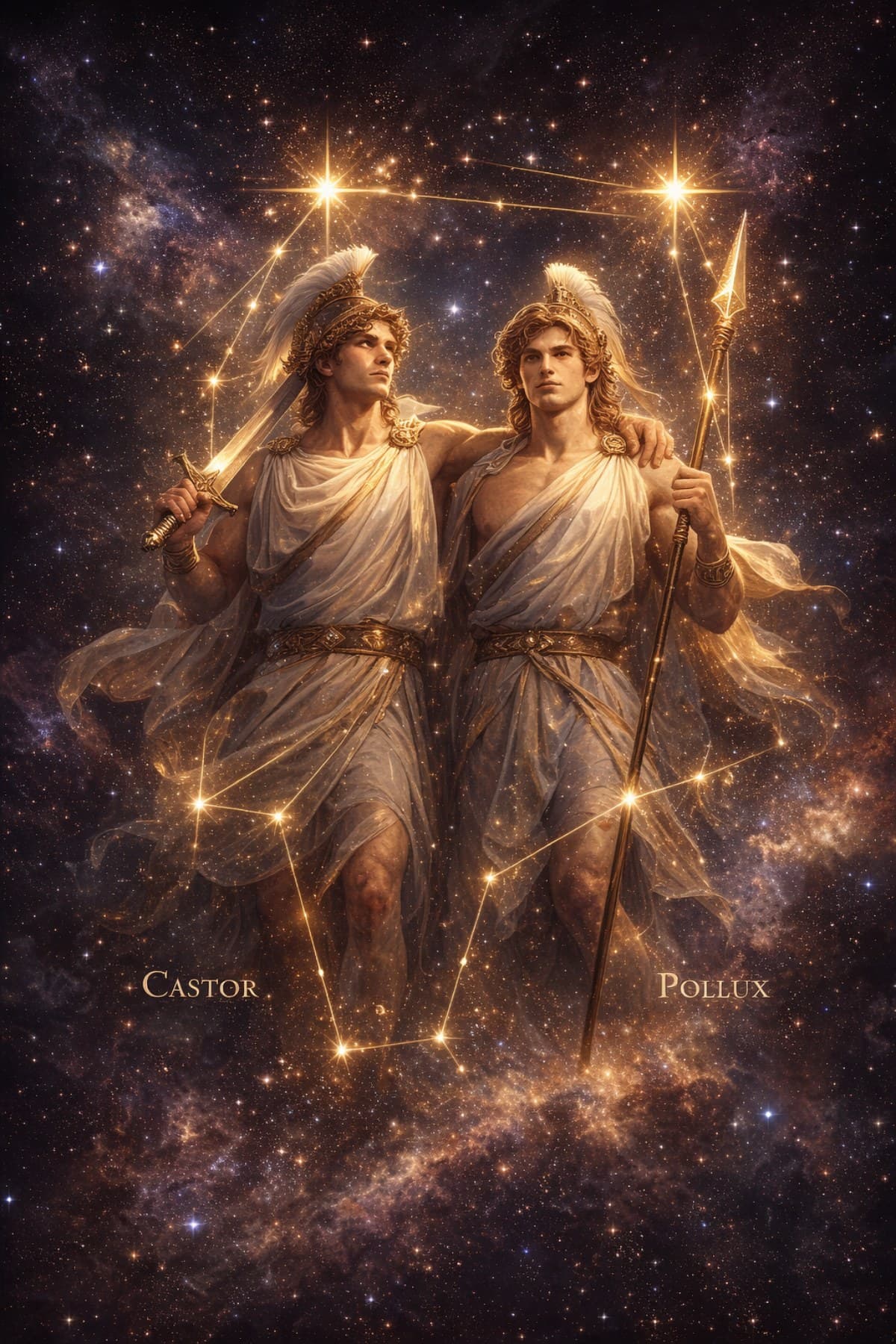
Gemini tells the Greek story of Castor and Pollux, the inseparable twin brothers whose bond became a constellation and a lasting symbol of loyalty, sacrifice, and shared immortality.
Constellation
Gemini
Tradition
Greek Mythology
Theme
Sky story, symbolism, and celestial memory
The constellation Gemini is associated with the legendary twin brothers Castor and Pollux, known in antiquity as the Dioscuri. They were the sons of Leda, queen of Sparta. According to the myth, on the same night Leda united both with her husband, Tyndareus, and with the god Zeus, who had transformed himself into a swan. From this double union eggs were born, from which the children emerged.
In the most widespread version of the myth, Castor was mortal, as the son of Tyndareus, while Pollux was immortal, as the son of Zeus. Despite their different natures, the two brothers were inseparable. They were renowned for their bravery and martial skill, took part in the Argonautic expedition, and were considered protectors of sailors.
The tragic turning point of the story occurs when, during a conflict with relatives, Castor is killed. Pollux, though immortal, cannot bear to live without his brother and begs Zeus to allow him to share his immortality. Moved by this profound brotherly love, Zeus decides either that the brothers would alternate their existence between Olympus and the Underworld, or — according to another version — that he would place them together in the sky as a constellation.
Thus, the constellation Gemini was created as an eternal symbol of brotherly loyalty, unity, and self-sacrifice. It expresses the duality of human existence — mortal and immortal, light and darkness, life and death — and the idea that true love transcends even death.
What is the story behind Gemini?
Gemini tells the Greek story of Castor and Pollux, the inseparable twin brothers whose bond became a constellation and a lasting symbol of loyalty, sacrifice, and shared immortality.
Which mythology is Gemini associated with?
Gemini is presented here through Greek mythology and its connection to the Gemini constellation.